
09.10.2025
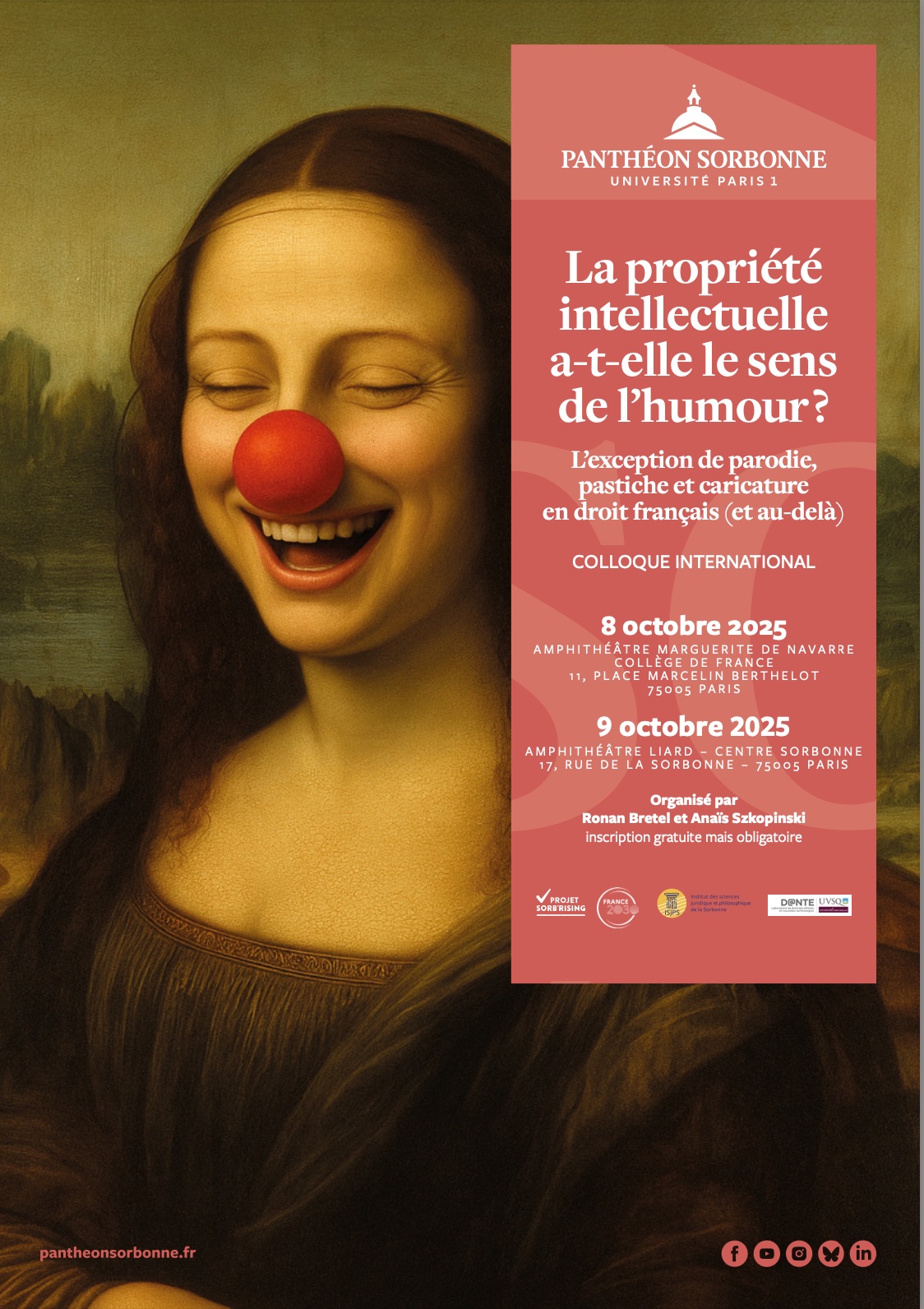
“‘Qui rido io’: the Italian right to parody and copyright”, La propriété intellectuelle a-t-elle le sens de l’humour ? L’exception de parodie, pastiche et caricature en droit français (et au-delà), Université Paris 1 Panthéon-Sorbonne, 17 rue de la Sorbonne, 75005 Paris, amphithéâtre Liard
Presentation
‘Qui rido io’: the Italian right to parody and copyright
Abstract
The legal problem underlying the conflict between parody and copyright does not necessarily have to be formulated in terms of an exception to the exclusive right, but can be framed in light of the originality of the work of authorship. In other words, parody usually constitutes an autonomous original work. To offer arguments in favor of this thesis, I will briefly analyze the evolution of the right to parody in Italy with particular attention to case law: from the landmark case D’Annunzio v. Scarpetta (1908) to the recent developments influenced by EU law and ECJ.
The right to parody has proven capable of resisting, in completely different constitutional and regulatory contexts, even the uncontrolled expansion of intellectual property. However, the Italian experience shows that in order to preserve the right to parody, it is necessary to be aware of the alternatives that exist in the formulation and resolution of legal problems. From this perspective, the Italian experience represents a model to be taken into consideration in other legal systems (e.g. France) where the legal problem of the conflict between parody and copyright tends to be formulated in terms of exceptions to exclusive rights.
Abstract in italiano
Il problema giuridico alla base del conflitto tra parodia e diritto d’autore non deve necessariamente essere formulato in termini di eccezione al diritto esclusivo, ma può essere inquadrato alla luce dell’originalità dell’opera d’autore. In altre parole, la parodia costituisce solitamente un’opera originale autonoma. Per offrire argomenti a favore di questa tesi, analizzerò brevemente l’evoluzione del diritto alla parodia in Italia con particolare attenzione alla giurisprudenza: dal caso storico D’Annunzio contro Scarpetta (1908) ai recenti sviluppi influenzati dal diritto dell’Unione Europea e dalla Corte di Giustizia Europea.
Il diritto alla parodia si è dimostrato in grado di resistere, in contesti costituzionali e normativi completamente diversi, anche all’espansione incontrollata della proprietà intellettuale. Tuttavia, l’esperienza italiana dimostra che per preservare il diritto di parodia è necessario essere consapevoli delle alternative esistenti nella formulazione e nella risoluzione dei problemi giuridici. Da questo punto di vista, l’esperienza italiana rappresenta un modello da prendere in considerazione in altri ordinamenti giuridici (ad esempio in Francia) dove il problema giuridico del conflitto tra parodia e diritto d’autore tende ad essere formulato in termini di eccezioni ai diritti esclusivi.